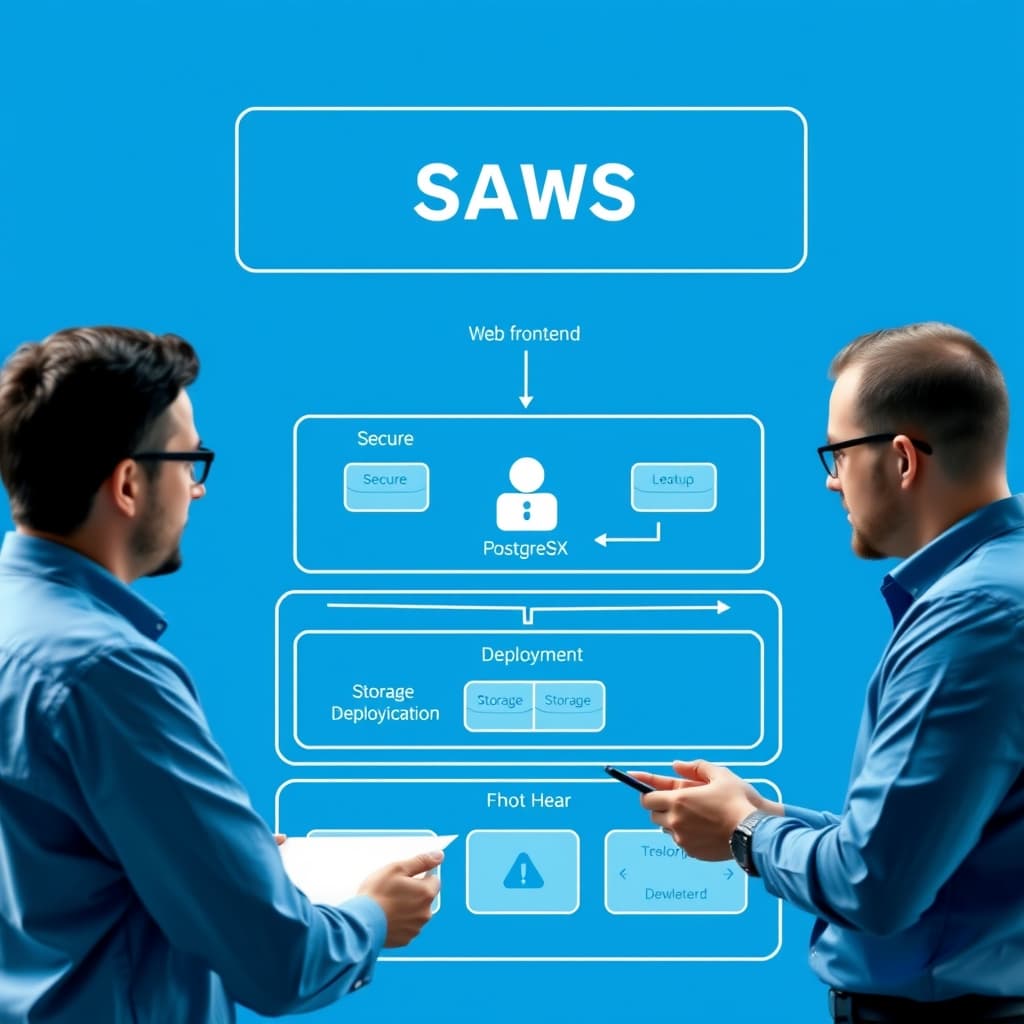
For SaaS product development in 2026, the Next.js Supabase SaaS stack offers a compelling blend of speed, developer experience, and scalability, leveraging modern web practices and a powerful open-source database. It's an excellent choice for many startups and products requiring rapid iteration with robust backend capabilities.
Last Updated: July 2026
The Allure of the Next.js Supabase SaaS Stack
In the evolving landscape of web development, the combination of Next.js and Supabase has emerged as a powerhouse for building modern SaaS applications. This stack capitalizes on Next.js's versatile frontend capabilities and full-stack features, coupled with Supabase's Postgres-centric backend-as-a-service (BaaS). Developers appreciate the integrated developer experience, the focus on open-source technologies, and the capacity for rapid prototyping that can scale to production.
For many teams, the appeal lies in minimizing the operational overhead of managing complex backend infrastructure while still retaining the flexibility and power of a relational database. This allows product teams to focus more on core features and user experience, which is crucial for competitive SaaS markets.
Core Components and Their Strengths
Next.js: Frontend & Full-stack Capabilities
Next.js, as a React framework, continues to push the boundaries of web application development. Its primary strengths for SaaS include:
- Server-Side Rendering (SSR) & Static Site Generation (SSG): These rendering strategies are vital for performance and SEO, ensuring initial page loads are fast and content is easily discoverable. For dynamic SaaS dashboards, SSR or Incremental Static Regeneration (ISR) can provide a fresh, personalized experience.
- React Server Components (RSC) & the App Router: Introduced in Next.js 13, RSCs enable developers to render components entirely on the server, significantly reducing client-side JavaScript bundles and improving perceived performance. The App Router provides a more opinionated and powerful way to handle routing, data fetching, and layouts, which simplifies complex SaaS application structures.
- API Routes & Server Actions: Next.js's built-in API routes and the newer Server Actions provide a streamlined way to handle backend logic directly within your Next.js project. This full-stack integration can drastically accelerate development, allowing developers to manage both frontend and backend logic in a unified codebase.
- Performance & User Experience: With features like automatic code splitting, image optimization, and pre-fetching, Next.js applications are inherently performant, leading to better user engagement and retention—critical metrics for SaaS products.
Supabase: Backend as a Service
Supabase positions itself as an open-source alternative to Firebase, built on PostgreSQL. Its features are exceptionally well-suited for SaaS:
- Postgres-First Approach: At its heart, Supabase is a managed PostgreSQL database. This means you get all the power, flexibility, and reliability of one of the world's most trusted relational databases. SQL is king, allowing complex queries, transactions, and robust data modeling essential for multi-tenant applications.
- Authentication: Supabase provides a comprehensive, out-of-the-box authentication system that supports email/password, social logins (Google, GitHub, etc.), magic links, and phone authentication. It uses JWTs (JSON Web Tokens) for secure session management, integrating seamlessly with Next.js for client-side authentication flows.
- Row-Level Security (RLS): This is a game-changer for multi-tenant SaaS. RLS allows you to define policies directly within your PostgreSQL database that restrict data access at the row level based on the authenticated user's identity. This is a powerful, database-enforced security mechanism, ensuring one tenant cannot accidentally or maliciously access another's data. For example:
This policy ensures users can only access rows where their authenticated user ID matches theCREATE POLICY tenant_isolation_policy ON public.customer_data FOR ALL USING (auth.uid() = tenant_id);tenant_idcolumn. - Storage: Supabase offers an S3-compatible object storage service for managing files, images, and other media. It includes built-in CDN integration, which is crucial for serving static assets quickly and reliably globally.
- Realtime: With Supabase Realtime, you can listen to database changes via WebSockets, enabling real-time features like live dashboards, notifications, and collaborative tools—all without setting up a separate real-time server.
- Edge Functions: Supabase also provides Edge Functions, powered by Deno, which are similar to serverless functions that can run at the edge, close to your users. These are ideal for lightweight backend logic, API proxies, or connecting to third-party services.
Development & Deployment Workflow
Developer Experience
The developer experience with the Next.js Supabase SaaS stack is generally positive. Both technologies prioritize a smooth workflow:
- Unified Tooling: With TypeScript support across both Next.js and Supabase (via generated types), developers benefit from strong typing and improved code quality.
- Local Development: Supabase offers a local development setup, mirroring its cloud services, which allows developers to build and test their applications entirely offline before deploying.
- Integrated Ecosystem: The tight integration means fewer context switches and a more cohesive development environment, from database migrations to API endpoint creation.
Deployment & Scalability
Deployment with this stack is often streamlined:
- Next.js Deployment: Next.js applications are commonly deployed to platforms like Vercel (its creator), Netlify, or can be self-hosted. Vercel offers deep integration with Next.js features like Server Components, image optimization, and edge functions, making deployment nearly frictionless.
- Supabase Deployment: Supabase is a managed service, handling database provisioning, backups, and scaling automatically. While you manage your database schema and RLS policies, Supabase handles the underlying infrastructure, allowing you to focus on application logic rather States
- Observability: Both Vercel and Supabase provide logging and analytics dashboards. Vercel offers insights into your Next.js application's performance, while Supabase provides database metrics and logs. Integrating third-party observability tools like Sentry or Datadog is straightforward for a more comprehensive view.
Key Considerations and Trade-offs
Vendor Boundaries and Integration
While the integrated experience is a strength, it also creates certain vendor boundaries:
- Supabase as a Managed Service: You rely on Supabase for your database, authentication, storage, and possibly edge functions. While open-source, migrating from Supabase's managed services to a self-hosted or alternative managed Postgres instance would require careful planning and execution.
- Vercel for Next.js: Similarly, leveraging Vercel's optimized deployment for Next.js provides immense benefits but ties you to their platform. While Next.js is open-source and deployable elsewhere, Vercel's ecosystem integrations are unique.
- Egress Costs: As with any cloud service, be mindful of data egress costs, especially for high-traffic applications or those dealing with large files stored in Supabase Storage.
Performance at Scale
The stack performs well for many applications, but certain considerations apply at extreme scale:
- Next.js Caching: Effective caching strategies (ISR, Vercel Edge caching) are paramount for Next.js applications to serve content rapidly under heavy load.
- Supabase Database Performance: While Postgres is powerful, large-scale applications may require careful database indexing, query optimization, and potentially scaling up your Supabase instance. RLS, while crucial for security, can introduce a slight performance overhead that needs to be factored in for very high-throughput operations. Connection pooling and efficient data fetching become critical.
When to Consider Alternatives
The Next.js Supabase SaaS stack is not a silver bullet. You might consider alternatives if:
- Extreme Performance Needs Beyond Postgres: If your core business logic requires highly specialized, non-relational databases (e.g., massive graph databases, custom time-series databases) or an extremely low-latency custom backend written in Go or Rust that can't easily integrate with Supabase's patterns.
- Complex, Non-Relational Data Models: While Postgres is versatile with JSONB and extensions, if your application's data model is overwhelmingly document-based or graph-oriented and doesn't naturally fit relational paradigms, a dedicated NoSQL database might be more appropriate.
- Strict On-Premise or Unique Compliance Requirements: Some industries or clients have mandates for on-premise deployments or very specific data residency/sovereignty rules that might make managed cloud services like Supabase unsuitable without significant customization or a hybrid approach.
- Desire for Complete Infrastructure Control: Teams with ample DevOps resources and a strong desire to manage every layer of their infrastructure for maximum customization or cost control might opt for entirely self-hosted solutions.
- Specific Backend Service Needs: If your application heavily relies on specific features not offered by Supabase (e.g., highly complex serverless orchestrations beyond simple functions, a very specific message queue implementation), you might need to build a custom backend or integrate other services.
Is the Next.js Supabase SaaS Stack Right for You?
For many SaaS ventures in 2026, especially those prioritizing rapid development, robust features, and manageable operational overhead, the Next.js Supabase SaaS stack presents a compelling proposition. It provides a solid foundation for building everything from MVPs to scalable, multi-tenant applications.
Its combination of modern frontend tooling, a powerful relational database, and comprehensive backend services allows developers to move quickly without compromising on security or scalability fundamentals. If you're looking to build a new web application or custom software solutions with this modern stack, consider reaching out to experienced developers. At DevKey Technologies, we specialize in web development services and can help you leverage these technologies effectively.