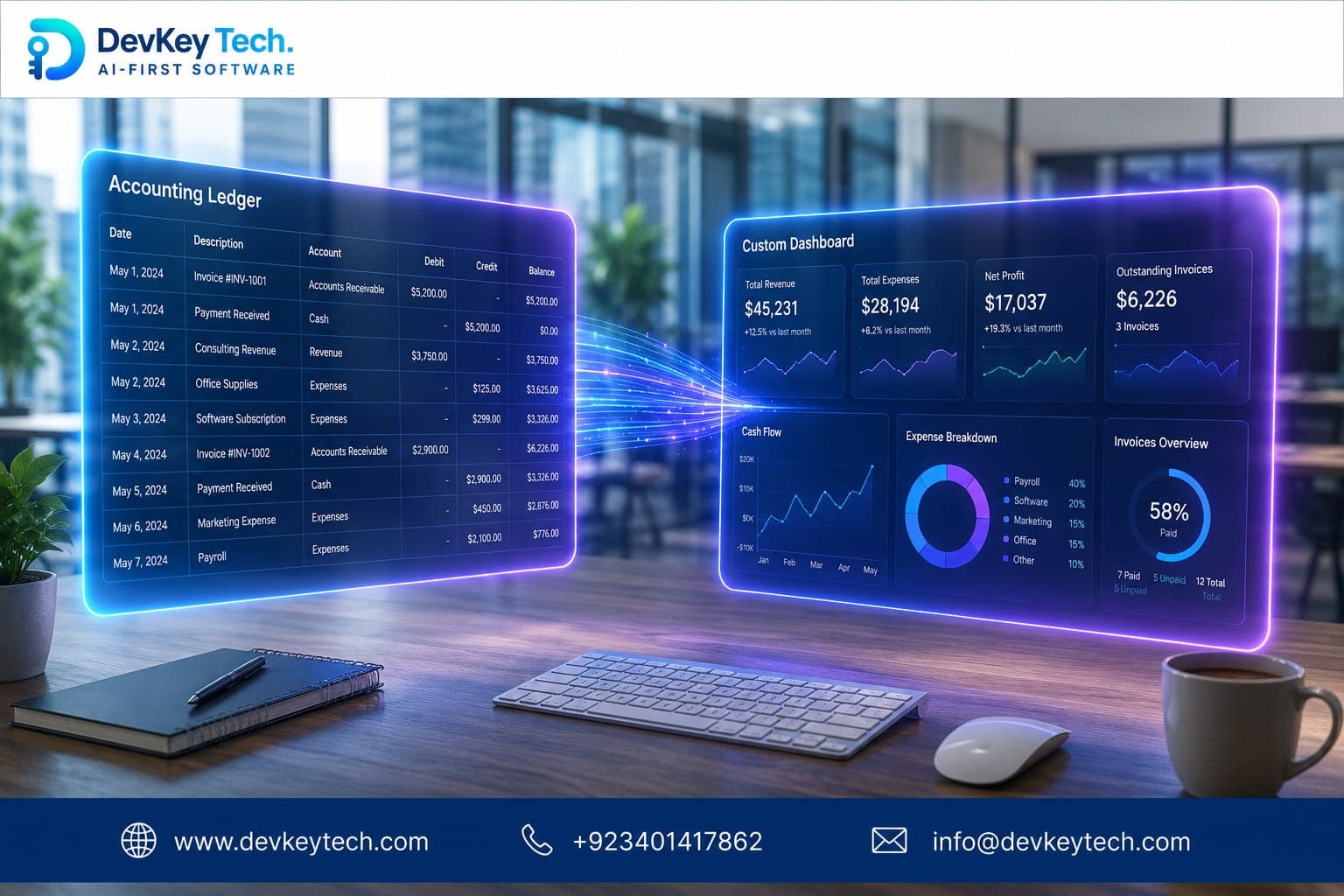
When your business outgrows off-the-shelf solutions and you decide to invest in custom software development, a critical question arises: what do you do about your existing accounting systems? The knee-jerk reaction might be to replace them entirely with a new, all-in-one platform. However, for most businesses, integrating custom software with the accounting tools they already rely on is a far more strategic, cost-effective, and less disruptive approach.
Why Integrate Instead of Replace?
Replacing a core system like accounting can feel like ripping out the foundation of your house while trying to live in it. It's often an unnecessarily complex, expensive, and risky endeavor. Integration, on the other hand, allows you to leverage your existing investments and build upon them.
1. Cost-Effectiveness
- Reduced Licensing & Training: You avoid new licensing fees for an entirely new accounting system and the significant cost of training your entire finance team on unfamiliar software.
- Lower Migration Overhead: Migrating years of historical financial data from one complex system to another is a monumental task, prone to errors, and consumes immense resources. Integration typically involves only the data relevant to the custom software's function.
- Focused Development: Custom software can concentrate solely on solving your unique operational challenges, rather than trying to replicate functionalities already handled well by your accounting system.
2. Minimized Disruption
Your finance team is accustomed to their current accounting software, whether it's QuickBooks, Xero, Sage, or a more specialized ERP. Introducing a completely new system can halt productivity, introduce errors, and create significant employee resistance. Integration allows them to continue working in a familiar environment while benefiting from enhanced automation and data flow from the new custom application.
3. Leveraging Existing Expertise and Data
Your team's proficiency with the current accounting system is a valuable asset. Integration preserves that expertise. Furthermore, your historical financial data, audit trails, and reporting structures remain intact, ensuring business continuity and compliance without a high-risk data migration.
Common Accounting Tools and Integration Approaches
Most modern accounting platforms provide mechanisms for external systems to interact with them. Understanding these mechanisms is key to a successful integration strategy.
Direct API Integration
Many popular accounting solutions offer Application Programming Interfaces (APIs). These are sets of rules and protocols that allow different software applications to communicate with each other. For instance, a custom CRM might use the accounting system's API to push new invoice data or retrieve payment statuses.
- REST APIs: Widely adopted, RESTful APIs are flexible and use standard HTTP methods for communication.
- SOAP APIs: Older but still prevalent in some enterprise systems, SOAP APIs are more structured and typically XML-based.
Our team at DevKeyTech has extensive experience working with various APIs for custom software development, ensuring robust and secure connections.
Middleware and iPaaS Solutions
For more complex scenarios involving multiple systems or intricate data transformations, a middleware layer or an Integration Platform as a Service (iPaaS) can be invaluable. These tools sit between your custom software and your accounting system, orchestrating data flow, translating data formats, and handling error management.
Smart integration isn't just about moving data; it's about automating workflows, improving data accuracy, and giving your business leaders real-time financial insights.
Key Considerations for a Successful Integration
Effective integration requires careful planning and execution. Here's what to keep in mind:
1. Data Mapping and Transformation
This is arguably the most critical step. How do fields in your custom software (e.g., customer ID, product code, invoice amount) correspond to fields in your accounting system? You'll need clear rules for data mapping, validation, and transformation to ensure consistency and prevent errors.
2. Authentication and Security
Any integration involving financial data must be secure. This includes using robust authentication methods (OAuth, API keys), encrypting data in transit and at rest, and adhering to compliance standards relevant to your industry.
3. Error Handling and Logging
Integrations will inevitably encounter errors – a dropped internet connection, an invalid data format, an API rate limit. Your integration solution must have robust error handling, logging, and alerting mechanisms to quickly identify and resolve issues, preventing data discrepancies.
4. Synchronization Strategy
Decide whether data needs to be synchronized in real-time (e.g., immediate invoice creation) or in batches (e.g., nightly sync of expenses). Real-time offers immediate visibility but can be more complex to implement and manage. Batch processing is often simpler and suitable for less time-sensitive data.
5. Scalability and Maintainability
As your business grows, your data volumes and integration needs may change. Design the integration with scalability in mind. Also, consider the long-term maintenance of the integration, especially when accounting software or API versions are updated.
6. Two-Way vs. One-Way Flow
Determine if data needs to flow in one direction (e.g., custom software pushes invoices to accounting) or both (e.g., custom software pushes invoices, and retrieves payment status updates). Two-way synchronization is more complex but offers richer functionality.
The DevKeyTech Advantage in Integration
At DevKey Technologies, we understand that custom software isn't just an isolated tool; it's part of a larger ecosystem. Our approach to custom software development emphasizes seamless integration with your existing infrastructure, especially critical systems like accounting platforms. We prioritize:
- Deep Understanding: We take the time to understand your specific business processes and how your current accounting tools fit into them.
- Robust Architecture: We design integration solutions that are secure, scalable, and resilient, minimizing future headaches.
- Transparent Communication: We work closely with your team, including finance stakeholders, to ensure the integration meets real-world needs.
Instead of undergoing a costly and risky overhaul, consider the power of smart integration. It's about optimizing your current setup, not abandoning it. If you're looking to enhance your business operations with custom software and want to discuss integration possibilities, we invite you to reach out to us.