Last updated: 29 July 2026
Short answer: WhatsApp AI works for a Pakistani business when it handles a narrow set of repetitive jobs—FAQs, product discovery, lead qualification, bookings and order capture—using clean business data and a visible human handoff. It fails when it is expected to improvise prices, policies or delivery promises from incomplete information.
Meta’s new Business Agent makes the category easier to enter, but “turning on AI” is not the same as building a dependable sales or support workflow. The useful question is not whether the bot can write a friendly reply. It is whether the reply is accurate, whether the next action reaches your order or CRM system, and whether a person can step in before the conversation goes wrong.
What can WhatsApp AI realistically automate?
For most SMEs, the first useful version should cover four or five repeatable conversations:
- Answer approved questions about hours, locations, delivery, returns and payment methods.
- Recommend products from a maintained catalogue.
- Collect a lead’s name, city, requirement, budget range and preferred callback time.
- Book an appointment against real availability.
- Capture an order and pass it to a person or order-management system for confirmation.
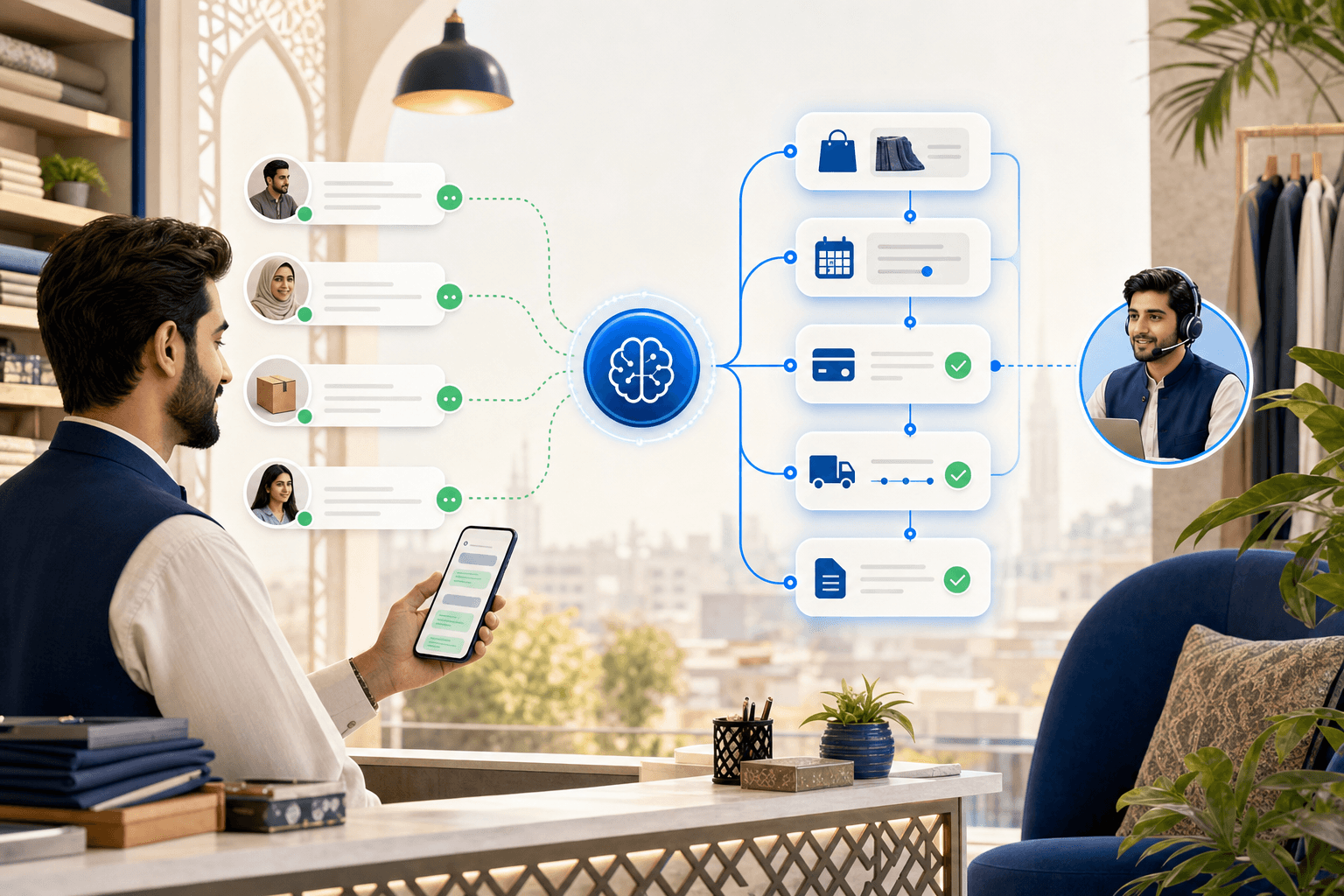
Meta says its Business Agent can answer business-specific questions, recommend catalogue products, book appointments, qualify leads and let a team member take over. That is a good list of boundaries. A Pakistani retailer may add COD availability, JazzCash or Easypaisa instructions, city-wise delivery estimates and Roman Urdu questions such as “kya rate hai?” or “Lahore delivery kab tak ho gi?”
The bot should not invent a discount, promise stock it has not checked, approve a return exception or diagnose a sensitive medical or financial issue. Those paths should immediately go to a person.
Meta Business Agent or a custom WhatsApp automation?
Meta announced the global expansion of Meta Business Agent in June 2026. It is the quickest starting point for an eligible small business that mainly needs catalogue questions, basic lead capture and a human takeover.
A custom workflow becomes useful when a conversation must change another system: reserve stock, calculate a delivery quote, create a CRM lead, check an order, schedule against a live calendar or send a structured task to an employee. That is where a focused AI automation system earns its cost.
| Choose | Best when | Main limitation |
|---|---|---|
| WhatsApp Business quick replies | Message volume is still manageable | Staff still performs every step |
| Meta Business Agent | You need fast FAQ, catalogue and lead automation | Eligibility, rollout and integrations may vary |
| BSP/no-code platform | You need team inboxes, templates and simple flows | Monthly platform cost and platform constraints |
| Custom Cloud API workflow | WhatsApp must connect to CRM, stock, orders or scheduling | More setup, testing and maintenance |
Do not start custom because it sounds more advanced. Start custom when a real workflow needs data or actions that the simpler option cannot provide.
Will it understand Urdu and Roman Urdu?
It can, but only after you test the language your customers actually use.
A clean demo in English proves very little for a shop receiving “blue wala medium mein hai?”, “COD ho jaye ga?” and voice notes with Urdu-English code-switching. Build a test set from anonymised real questions. Include spelling variations, short messages, voice notes, product nicknames, cities and ambiguous phrases.
For every test, score:
- Was the intent understood?
- Was the answer grounded in approved information?
- Did the system ask a clarifying question when needed?
- Did it avoid promising an unverified price, stock level or delivery time?
- Did it hand off at the correct moment?
Keep a human in the loop for the first four to six weeks. Review failed or corrected conversations weekly and improve the source information—not just the prompt.
What information must be ready first?
The AI is usually the easy part. Messy business information is the real blocker.
Before implementation, prepare one approved source for:
- Product names, variants, prices and stock rules
- Business hours and branch locations
- Delivery zones, fees and realistic timelines
- COD, bank transfer, JazzCash and Easypaisa instructions
- Exchange, return and warranty policies
- Booking duration, availability and cancellation rules
- Escalation contacts and working hours
If three employees give three different answers about delivery to Rawalpindi, the bot cannot discover the “right” one. Agree on the policy first. A simple maintained spreadsheet is better than ten outdated PDFs.
What should the conversation flow look like?
A dependable flow is intentionally boring:
- Identify the intent. Product question, order, booking, support or something else.
- Retrieve approved information. Answer only from the catalogue, policy or connected system.
- Confirm important details. Repeat the item, quantity, city, date or contact information.
- Take a controlled action. Create a lead, draft an order or reserve a slot.
- Hand off with context. Give the employee a concise summary so the customer does not repeat everything.
For an order, the AI can collect the customer’s name, phone, city, address, product and quantity. A person or verified system should confirm stock, final delivery charge and dispatch commitment before the order becomes final.
If your current operation is spread across WhatsApp, notebooks and Excel, read our guide to AI automations for Pakistani SMEs before automating a single conversation.
How much does WhatsApp AI cost?
There is no honest single price. The cost has four layers: Meta messaging charges where applicable, a provider or inbox subscription, AI usage, and implementation/integration work.
| Cost layer | What changes it | How to budget |
|---|---|---|
| Meta messaging | Message category, market and current rate card | Check Meta’s live pricing before launch |
| Platform/BSP | Seats, contacts, automation and inbox features | Compare monthly plans using your real volume |
| AI model | Number and length of conversations | Set a usage cap and review monthly |
| Build/integration | Number of systems, actions and edge cases | Scope one workflow before expanding |
| Maintenance | Policy, catalogue and flow changes | Assign a named owner internally |
Any proposal that gives a final monthly number without asking about conversation volume, team size, integrations and countries is guessing. Meta also says Business Agent is initially free to start, with paid subscription options planned, so current pricing should be verified rather than copied from an old blog post.
How do you prevent wrong answers?
Use controls at three levels.
1. Limit the knowledge
The bot should answer business questions from approved sources. If information is missing, it should say so and transfer the chat instead of filling the gap.
2. Limit the actions
Separate “draft an order” from “confirm an order.” Require validation before changing stock, issuing a refund, confirming an appointment or sending a payment instruction.
3. Monitor the outcomes
Track more than response speed:
- Percentage of conversations resolved without correction
- Human-handoff rate by intent
- Leads with complete contact and requirement data
- Orders rejected because of wrong stock, price or delivery information
- Customer opt-outs and complaints
- Conversations where staff rewrote the AI answer
The useful ROI calculation is hours saved plus additional qualified opportunities, minus software, implementation and correction time. Do not call every automated reply a success.
When should you not automate WhatsApp?
Do not automate yet when:
- You receive only a few manageable enquiries per day.
- Prices and policies change informally and nobody owns the source data.
- Most conversations are complex negotiations.
- The workflow handles sensitive personal information without a reviewed privacy and access plan.
- There is no employee responsible for escalations.
Quick replies, labels and a shared operating procedure may solve the problem more cheaply. Automation is justified when message volume, repetition or missed follow-ups create a measurable bottleneck.
A practical 30-day rollout
Week 1: audit. Export or sample recent conversations, remove personal information, group them by intent and identify the top repetitive questions.
Week 2: prepare. Clean the catalogue and policies, write escalation rules, choose one workflow and create a test set containing English, Urdu and Roman Urdu examples.
Week 3: pilot. Launch to a limited segment or during selected hours. Keep every important action behind human confirmation.
Week 4: measure. Review wrong answers, handoffs, staff corrections, qualified leads and time saved. Expand only after the first workflow is reliable.
If you want a second opinion, bring twenty anonymised WhatsApp conversations to a short automation discovery call. We can tell you which part is worth automating, which part should stay human, and whether you need custom software at all.