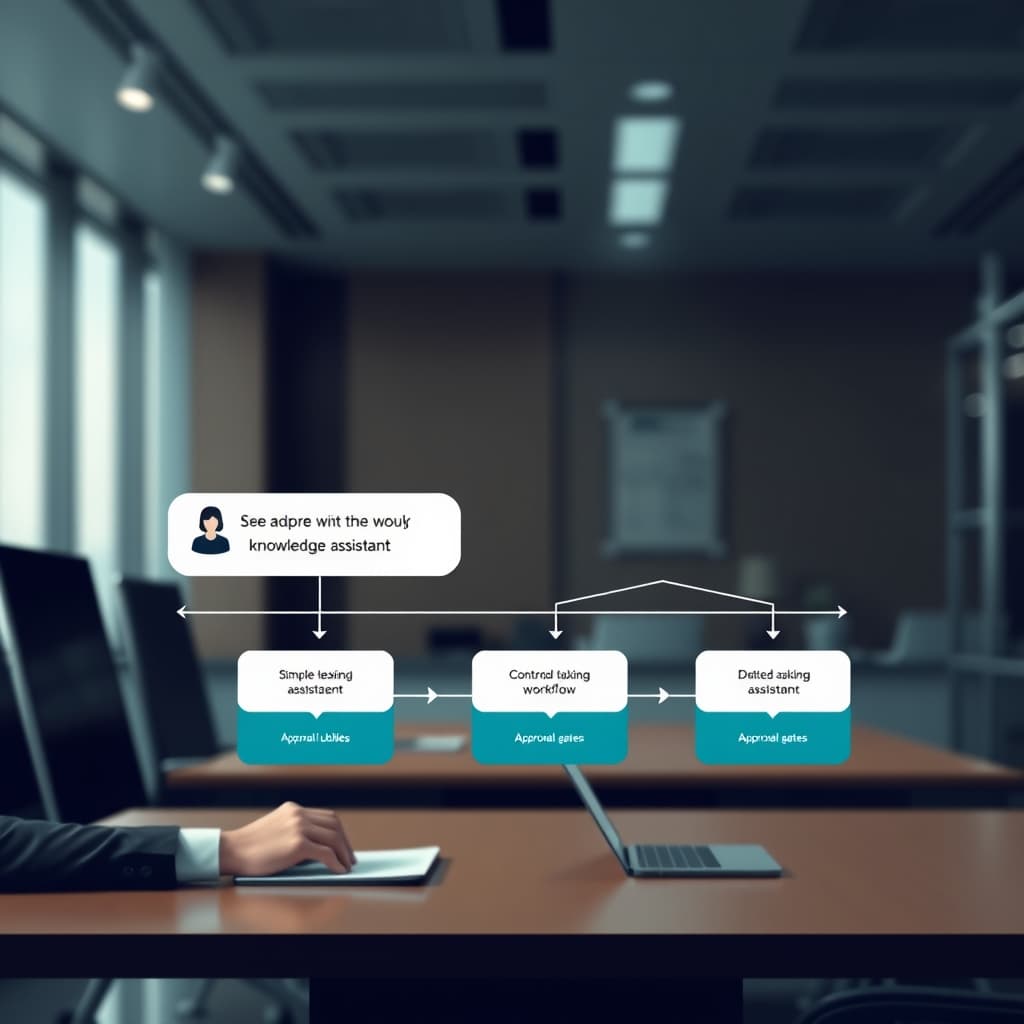
When considering an AI chatbot vs AI agent for business, understanding their fundamental differences is crucial. Rule-based chatbots follow scripts, retrieval-based AI assistants leverage knowledge bases for information, while action-taking AI agents execute tasks autonomously. Choosing the right tool impacts automation, risk, and integration complexity, directly influencing operational efficiency and cost.
Understanding the AI Landscape for Business
The promise of Artificial Intelligence to transform business operations is compelling, yet the market is often awash with confusing terminology. For small and medium-sized enterprises (SMEs), knowing the practical distinctions between various AI tools is essential for making informed investments. It’s not about deploying AI for AI’s sake, but about selecting the right tool to solve specific problems, enhance customer experiences, or streamline internal workflows effectively and securely.
At DevKeyTech, we emphasize a clear, pragmatic approach to AI adoption. This article cuts through the hype to explain what each type of AI system truly offers, its practical implications, and what to consider before integrating it into your business.
Differentiating AI Tools: From Chatbots to Agents
Rule-Based Chatbots: The Scripted Responders
Rule-based chatbots are the most straightforward form of conversational AI. They operate on predefined rules, keywords, and decision trees. When a user inputs a query, the chatbot attempts to match it against its programmed scripts. If a match is found, it delivers a predetermined response.
- Capabilities: Excellent for answering frequently asked questions (FAQs), guiding users through simple processes, and basic lead qualification. They provide consistent, predictable responses.
- Limitations: Lack understanding beyond their programmed rules. They struggle with novel queries, synonyms, or complex conversational nuances, often leading to frustrating dead ends for users.
- Use Cases for SMEs: Customer service for common queries (e.g., store hours, return policies), website navigation assistance, basic form completion, or initial triage for support requests.
Retrieval-Based AI Assistants: The Smart Information Providers
Retrieval-based AI assistants represent an advancement over rule-based chatbots. These systems utilize natural language processing (NLP) to understand user intent and then retrieve relevant information from a vast, indexed knowledge base. They don't generate new text; rather, they find the most pertinent existing answer.
- Capabilities: Can handle a broader range of questions than rule-based chatbots by understanding context. They excel at providing detailed information drawn from internal documents, product manuals, or company wikis.
- Limitations: While smarter, they still can't engage in free-form conversation or perform actions outside of retrieving data. Their effectiveness is highly dependent on the quality and comprehensiveness of their knowledge base.
- Use Cases for SMEs: Enhanced customer support (answering complex product questions, troubleshooting guides), internal knowledge management for employees, or more sophisticated lead qualification that requires access to detailed information. For example, our insights on WhatsApp AI for Pakistani Businesses often involve retrieval-based systems to provide quick, relevant answers.
Action-Taking AI Agents: The Autonomous Executors
Action-taking AI agents (or autonomous AI agents) are the most sophisticated type. Beyond understanding and retrieving information, they are designed to perform tasks by interacting with other systems via APIs (Application Programming Interfaces). This means they can initiate and complete actions on behalf of the user or business.
- Capabilities: Can update CRM records, schedule appointments, process orders, send personalized emails, manage inventory, or even execute multi-step workflows across various software platforms. They often involve a planning component that breaks down a complex request into a sequence of actionable steps.
- Limitations: Higher complexity, significant security considerations, and the potential for unintended actions. Requires robust integration with existing systems, clear permissions, and often human oversight.
- Use Cases for SMEs: Automating repetitive backend tasks (e.g., invoice processing, updating customer profiles after a call), personalized marketing outreach, automated order fulfillment, or complex scheduling.
Key Considerations: AI Chatbot vs AI Agent for Business
Choosing the right AI for your business requires a thorough evaluation of several practical factors:
Capabilities & Complexity
Rule-based chatbots offer simplicity and control but limited scope. Retrieval-based assistants provide greater flexibility in information delivery. Action-taking agents offer unparalleled automation potential but come with significant complexity in design, implementation, and ongoing management. Consider whether your needs are for simple information dissemination or genuine task automation.
Risk & Security
The risk profile escalates significantly from chatbots to agents. A rule-based chatbot has minimal risk; at worst, it might give a wrong answer. A retrieval-based assistant might misinterpret a query. An action-taking AI agent, however, if misconfigured or compromised, could potentially execute incorrect transactions, access sensitive data, or make unauthorized changes across integrated systems. Robust security protocols, access controls, and data encryption are paramount for agents.
Integrations & Permissions
Basic chatbots require minimal integration. Retrieval-based assistants need access to a well-maintained knowledge base. Action-taking agents, however, demand seamless, secure API integrations with every system they are expected to interact with (e.g., CRM, ERP, payment gateways). Defining precise permissions for what an agent can and cannot do is critical to prevent unintended consequences.
Audit Logs & Human Approval
For any AI system handling critical business functions, comprehensive audit logs are indispensable. For action-taking agents, audit trails must meticulously record every action taken, when, by whom (or what AI identity), and with what outcome. Furthermore, integrating human approval checkpoints for high-stakes actions is often a non-negotiable requirement, allowing for review before sensitive tasks are finalized.
Cost & Maintenance
Development and maintenance costs generally scale with complexity. Rule-based chatbots are typically the least expensive to implement and maintain. Retrieval-based assistants require investment in a quality knowledge base and NLP tuning. Action-taking AI agents involve significant upfront investment in development, integration, security, and ongoing monitoring and governance.
Appropriate Use Cases for SMEs
For many SMEs, starting with a rule-based chatbot or a retrieval-based AI assistant offers immediate value with manageable risk. They can significantly offload customer support or provide internal knowledge efficiently. Action-taking agents, while powerful, demand a higher degree of technical sophistication, robust internal processes, and a clear understanding of the workflows to be automated. Consider automating single, well-defined tasks first before scaling.
Decision Checklist: Choosing Your Business AI
Before committing to an AI solution, ask these questions:
- What specific problem are we trying to solve?
- Is the primary goal information provision or task execution?
- What is the complexity of the user queries or tasks?
- What existing systems would the AI need to interact with?
- What is our risk tolerance for automation errors?
- What budget do we have for initial development and ongoing maintenance?
- How critical is real-time human oversight for the tasks in question?
- Do we have the technical resources to manage integrations and security?
Getting Started with AI Automation
Implementing AI solutions, particularly action-taking agents, requires careful planning, a clear understanding of your business processes, and robust technical expertise. It’s not just about selecting technology; it’s about strategically integrating it into your operations to achieve measurable benefits while mitigating risks.
If you're exploring how AI automation can benefit your business, from enhancing customer interactions to streamlining back-office operations, consider reaching out to experienced partners. Learn more about how we can help you navigate these options by exploring our AI Automation Services.