
E-learning PlatformDevelopment
Run your courses on a platform you own: structured lessons, tracked progress, assessments and payments, shaped around how you actually teach.
E-learning Platform Development: what the work involves
Many teachers and training companies begin by sending video links in a group chat and collecting payment into a bank account. That works until there are a few hundred learners: nobody knows who has paid, who finished which lesson, or who cheated on the quiz. Generic course marketplaces solve some of this but take control of pricing, branding and the student relationship. A dedicated platform lets you decide how content is released, how learners are assessed and what completion means.
We model courses as modules and lessons, with enrolment rules that decide who can see what and when. Video is hosted on a streaming service so playback adapts to weak connections, and learner progress is saved per lesson. Quizzes are graded automatically and results feed certificates generated on completion. Payment unlocks enrolment through card or local wallet, with cohort start dates and drip release for live-style programs. An instructor area lets teachers upload, review submissions and message students.
Core features
Course, module and lesson structure
Content is arranged into ordered modules with video, reading and downloadable resources, and learners resume exactly where they stopped.
Quizzes and graded assignments
Multiple-choice quizzes grade instantly, while written or file assignments queue for an instructor to mark with feedback.
Enrolment and access rules
Access can depend on payment, cohort start date, prerequisites or manual approval, with expiry dates for time-limited courses.
Certificates with verification
Completion generates a certificate with a unique code that a third party can check on your site.
Progress dashboards
Learners see completion by course, and instructors see who is stuck, who has dropped off and which lessons are replayed most.
Discussion and instructor messaging
Per-lesson questions and a private channel to the instructor keep support inside the platform instead of scattered messages.
What we get right before launch
Protecting paid video
Unprotected video files are shared within days. Signed streaming URLs, domain restrictions and per-user watermarks deter casual leaking, though no method stops a determined recorder.
Delivery on weak connections
Many learners study on mobile data. Adaptive streaming, downloadable notes and light pages decide whether people finish or quit.
Assessment integrity
Open-book quizzes are easy to share. Question banks, randomised order and time limits reduce copying, and high-stakes exams may need supervised sessions.
Tools and technology
- Next.js
- React
- TypeScript
- Supabase / PostgreSQL
- Node.js
- Stripe
- JazzCash
- Cloudinary
- Tailwind CSS
- Vercel
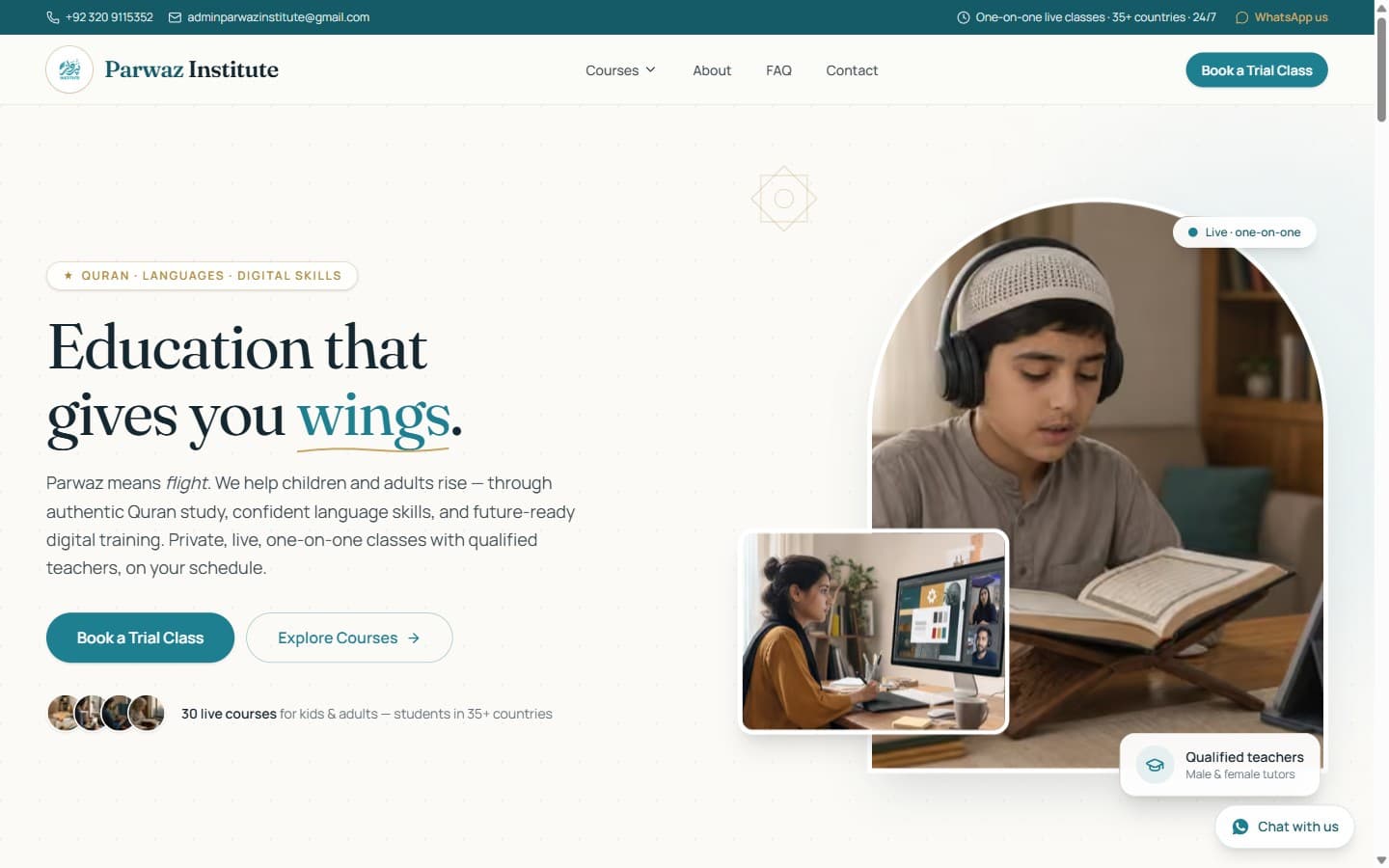
Related work · Online Education Platform
Parwaz Institute
Parwaz means flight. Thirty live one-on-one courses across Quran study, seven languages and digital skills — taught to students in 35+ countries, on their own timezone.
Common questions, answered
Why build a platform instead of using a ready-made LMS?
A ready-made LMS is quicker to start and fine for simple needs. Custom makes sense when you want your own branding, local payments, particular assessment rules or integration with your other systems.
Can we run live classes on it?
We embed or link to a live-class tool such as Zoom or Google Meet, schedule sessions on the course calendar and store recordings in the lesson list. Building a video-conferencing engine is not worth it.
How do learners pay?
By card or local wallet, with options for one-off courses, bundles or instalments. Successful payment unlocks enrolment automatically so nobody waits for manual approval.
Can we sell to learners outside Pakistan?
Yes. International card payments, a currency display choice and time-zone aware cohort dates let you teach learners in Australia, the US or the Gulf from the same platform.
More Web Development services
All Web Development servicesCoaching Academy Website Development
Coaching is sold on timetables and results. Show your batches, your teachers and your track record, and let students register without visiting the office first.
Tutor Marketplace Website Development
A tutoring marketplace that matches students with verified teachers, schedules lessons and handles payments, without parents hunting through WhatsApp groups.
University Website Development
A university site serves applicants, current students, faculty and researchers at once. Structure it so each of them reaches the right page in two clicks.
Ready to start your E-learning Platform Development project?
Tell us what you need and we will come back with a clear scope, timeline and the questions worth answering before any build starts.