
Booking EngineDevelopment
A booking core that holds inventory, prices it by your rules and confirms reservations safely under heavy demand.
Booking Engine Development: what the work involves
A booking engine is the part of a product that answers one question reliably: is this thing available on this date for this price, and can it be reserved right now? Spreadsheets and chat threads cannot answer that when demand rises. Overbookings, stale prices and payments that succeed without a reservation are the typical results.
DevKey engineers booking engines as a focused service with clear boundaries. Inventory may be rooms, vehicles, seats, venues or provider time, and each has availability calendars, rate plans, minimum stays and blackout dates. The engine reserves inventory atomically, takes payment, issues a confirmation and exposes an API, so your website, a mobile app and partner channels all use the same source of truth.
Core features
Availability calendar
Inventory counts, holds and bookings are tracked per date or time slot, so the search always reflects what can be confirmed.
Rate and rule engine
Seasonal rates, weekday pricing, extra-person charges, minimum stays, lead-time rules and promotions combine into a transparent quote.
Temporary holds
While a customer pays, the inventory is held for a short window and released automatically if payment is not completed.
Payment orchestration
Deposits, full payment and refunds run through card gateways or local wallets, and a reservation is confirmed only once the payment state is settled.
Provider and admin console
Suppliers manage their own inventory, rates and blackout dates, while the operator sees every booking, status and payout owed.
Public API and webhooks
Versioned endpoints let websites, apps and partners search, quote and book, and webhooks notify downstream systems of confirmations and cancellations.
What we get right before launch
Atomic reservation
Overbooking happens when availability is checked and written in separate steps. We make the check-and-reserve one transaction, and test it with simulated simultaneous requests.
Reconciling payments with bookings
Gateways can confirm a payment after the customer closes the browser. We drive state from webhooks and run a reconciliation job, so no paid booking stays unconfirmed and no unpaid one is honoured.
Channel sync
If the same inventory is sold on several channels, delays create conflicts. We agree a source of truth, use idempotent updates and design the sync to retry safely.
Tools and technology
- Node.js
- TypeScript
- PostgreSQL
- Prisma
- Redis
- Next.js
- Stripe
- GraphQL
- Message queues
Related work · Local Services Marketplace
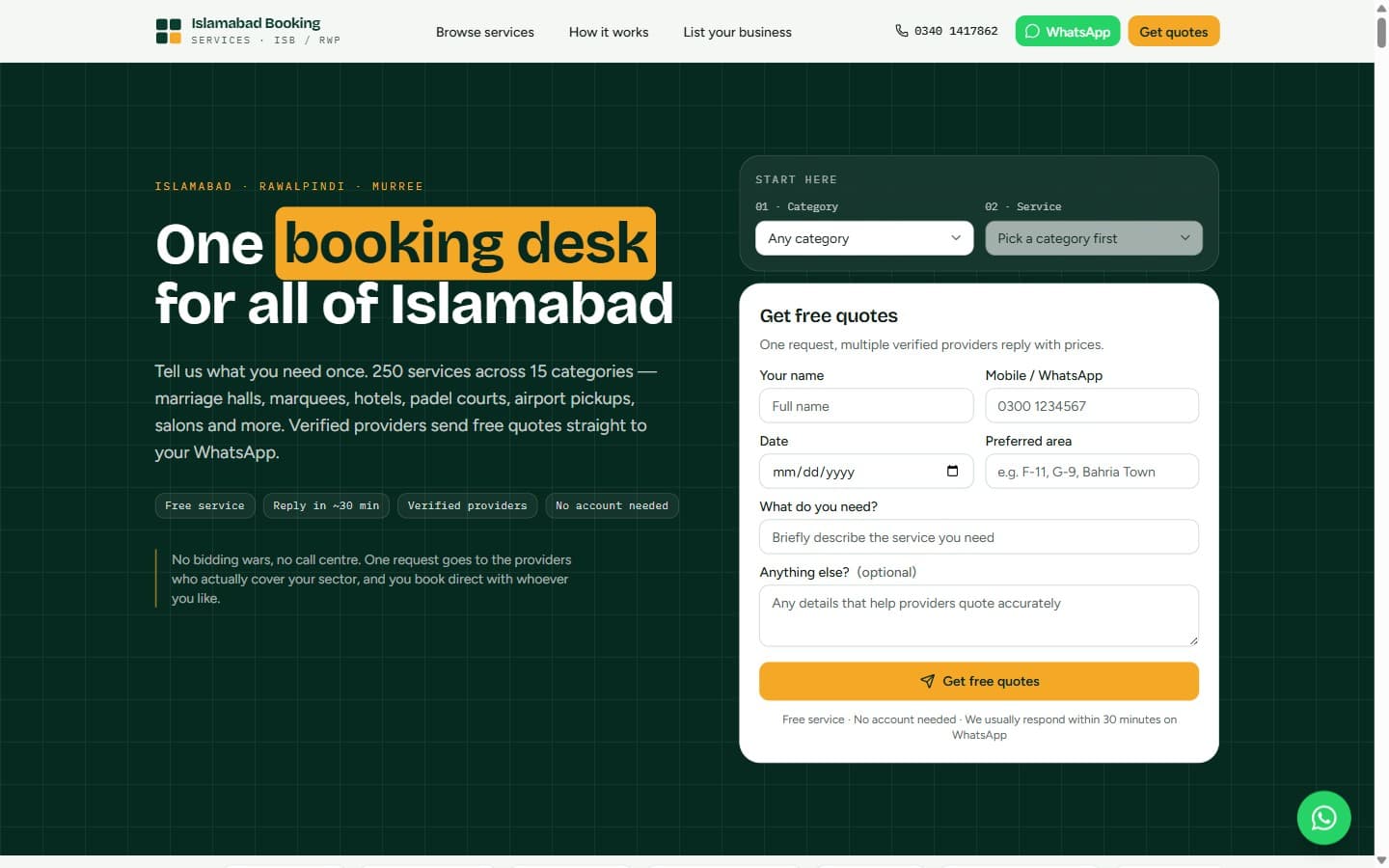
Islamabad Booking Services
Tell it what you need once. 250 services across 15 categories — marriage halls, marquees, hotels, padel courts, airport pickups and salons — answered by verified providers with free quotes on WhatsApp.
Common questions, answered
Why build a booking engine rather than buy one?
Off-the-shelf engines suit standard hotels. A custom engine fits unusual inventory, pricing logic, local payment methods or marketplace payouts, and you own the data and roadmap rather than renting features.
Can it be used by our website and our mobile app?
Yes. The engine exposes one versioned API, so both front ends, and any partner, search and book against the same inventory and rules without duplicating logic.
How are overbookings prevented?
Availability checks and reservations happen inside one database transaction, with short holds during payment. We load-test concurrent bookings of the same slot before launch to confirm only one succeeds.
What affects the cost?
The complexity of inventory and rate rules, the number of payment methods, provider self-service, channel integrations and expected peak traffic. We define these in discovery and quote a fixed scope.
More Custom Business Software services
All Custom Business Software servicesAppointment Scheduling Software Development
Let clients pick a slot that really is free, remind them before it, and keep your calendar full without phone tag.
Rental Management Software Development
Track what is rented, to whom and until when, from quote and deposit to return, damage check and final invoice.
Hotel Management Software Development
Run reservations, check-in, housekeeping, guest folios and night audit as one connected flow, so rooms are sold once and billed correctly.
Ready to start your Booking Engine Development project?
Tell us what you need and we will come back with a clear scope, timeline and the questions worth answering before any build starts.