
Multi-Tenant SaaSDevelopment
One platform serving many organisations, each with isolated data, its own branding and configuration, and no chance of seeing one another's records.
Multi-Tenant SaaS Development: what the work involves
Multi-tenancy is the decision that lets one codebase serve a hundred customers economically, and the decision that can leak one customer's data to another if made carelessly. Every query, background job, file upload and report must know whose data it touches. Adding that awareness late means touching everything, so the tenancy model needs to be settled before the first table is created.
DevKey implements multi-tenancy at the data layer. With PostgreSQL we typically use a tenant identifier on every table enforced by row-level security policies, so the database itself refuses cross-tenant reads even if application code has a bug. Tenant-specific settings, custom domains, branding and feature flags sit in configuration. We test isolation explicitly and design migrations, backups and per-tenant exports so operating many tenants remains manageable.
Core features
Tenancy model selection
We compare shared schema, schema-per-tenant and database-per-tenant against your size, security and cost needs and document the choice.
Row-level security
Database policies bind every query to the current tenant, adding a safety net underneath the application logic.
White-label branding
Logos, colours, email templates and custom domains per tenant let each customer present the product as its own.
Per-tenant configuration and flags
Plans, modules, limits and settings are stored per tenant, so features can be switched on for some customers without separate deployments.
Tenant onboarding automation
Creating a new tenant provisions its records, roles, defaults and domain through one reliable, repeatable process.
Tenant-level operations
Export a single tenant's data, restore one tenant, view usage per tenant and disable an account without affecting the others.
What we get right before launch
Noisy neighbours
One heavy tenant can slow the others. We add rate limits, queue fairness and indexing designed around tenant identifiers, and can move a large tenant to dedicated resources.
Background jobs and files
Isolation bugs hide in jobs, caches and storage buckets. Every queue message and file path carries the tenant, and we test that jobs cannot cross the boundary.
Migrations across many tenants
Schema changes must work for everyone at once. We write backward-compatible migrations, roll them out in stages and keep a way to hold back a tenant with unusual data.
Tools and technology
- PostgreSQL
- Supabase
- Next.js
- TypeScript
- Node.js
- Prisma
- Redis
- Docker
Related work · SaaS · Practice Management
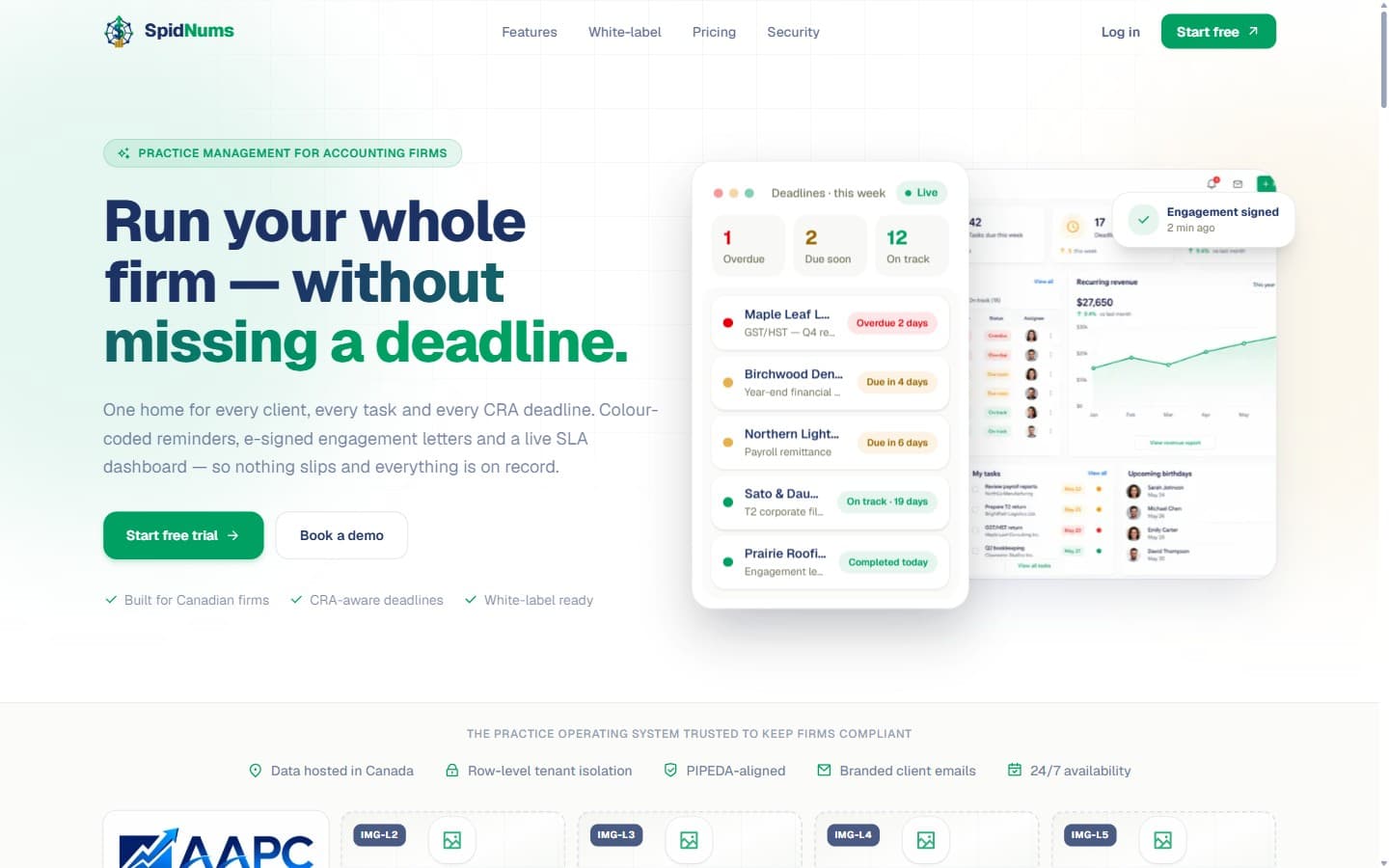
SpidNums
Cloud practice-management software for Canadian accounting firms — client CRM, CRA-aware deadline tracking, Kanban task management, e-signature engagement letters, and white-label, with Canadian data residency.
Common questions, answered
Is shared-database multi-tenancy secure enough?
With row-level security, tested isolation and disciplined access it is suitable for most products. Customers with strict regulatory or contractual needs may require separate databases, and we can design for that option.
Can each customer use its own domain and branding?
Yes. Tenants can have a subdomain or their own domain, a logo, colours and email templates. The platform resolves the tenant from the domain and applies the matching settings throughout the interface.
Can we convert an existing single-customer app?
Usually, but it involves adding tenant identifiers to the data model, scoping every query and reworking authentication. We audit the codebase first, then plan the migration so existing customers continue without interruption.
How do you prove isolation works?
We write automated tests that sign in as one tenant and attempt to read or change another's records through every endpoint and job, and we review database policies separately from application code.
More Custom Business Software services
All Custom Business Software servicesSaaS Product Development
Build a software product that many customers subscribe to, with the billing, onboarding and operations a service needs behind the features.
API Development Services
Well-designed REST and GraphQL interfaces that let your apps, partners and systems share data reliably and securely.
MVP Software Development
A focused first version that tests whether people want your product, built on foundations you can keep growing.
Ready to start your Multi-Tenant SaaS Development project?
Tell us what you need and we will come back with a clear scope, timeline and the questions worth answering before any build starts.