
Order Management SoftwareDevelopment
Capture every order once, check stock and credit before you accept it, and follow it through fulfilment, delivery and invoice without retyping.
Order Management Software Development: what the work involves
Orders reach a business through many doors: a customer on the phone, a salesman's notebook, a WhatsApp voice note, a web form. Each door ends in a different piece of paper, and someone must reconcile them before the warehouse can pick. Orders are promised against stock that was already sold, shipped in part without the balance being tracked, and invoiced differently from what was agreed. Customers lose patience, and staff lose hours on status calls.
DevKey builds order management around a single order record with lines, prices, status and fulfilment history. Orders enter from a web portal, a staff screen or a salesman app; availability and credit checks run at entry; and approved orders become pick lists, partial shipments and invoices. Back orders are tracked until filled, customers can see status without calling, and managers see a pipeline of open orders by age, value and reason for delay. Pricing follows customer-specific lists and agreed discounts.
Core features
Multi-channel order entry
Orders arrive from a customer portal, staff entry, salesman app or file import, all landing in one queue with the source recorded.
Customer-specific pricing
Price lists by customer or group, quantity breaks, agreed discounts and validity dates applied automatically to each line.
Stock and credit checks
Availability and credit limit are verified at entry, with soft allocation of stock and holds routed to an approver.
Partial fulfilment and back orders
Orders ship in parts, outstanding quantities remain open as back orders, and substitutions need customer-agreed approval.
Order lifecycle and status
Received, approved, picked, dispatched and delivered statuses, visible to staff and to customers through a tracking page.
Invoicing and returns
Invoices follow actual shipped quantities, and returns or order amendments produce credit notes tied to the original order.
What we get right before launch
One source of order truth
Orders edited in chat and spreadsheets diverge from the system. We make the system the only place an order is confirmed, and design entry to be quicker than the informal alternative.
Amendments after approval
Customers change orders after confirmation. We version orders, show what changed and who approved it, and block edits once picking has started unless a supervisor intervenes.
Sync with stock and accounts
Order data must agree with inventory and the ledger. We reserve and release stock through defined events and post invoices to accounts automatically or by export.
Tools and technology
- Next.js
- React
- TypeScript
- Node.js
- PostgreSQL
- Prisma
- Redis
- Docker
- GraphQL
- REST APIs
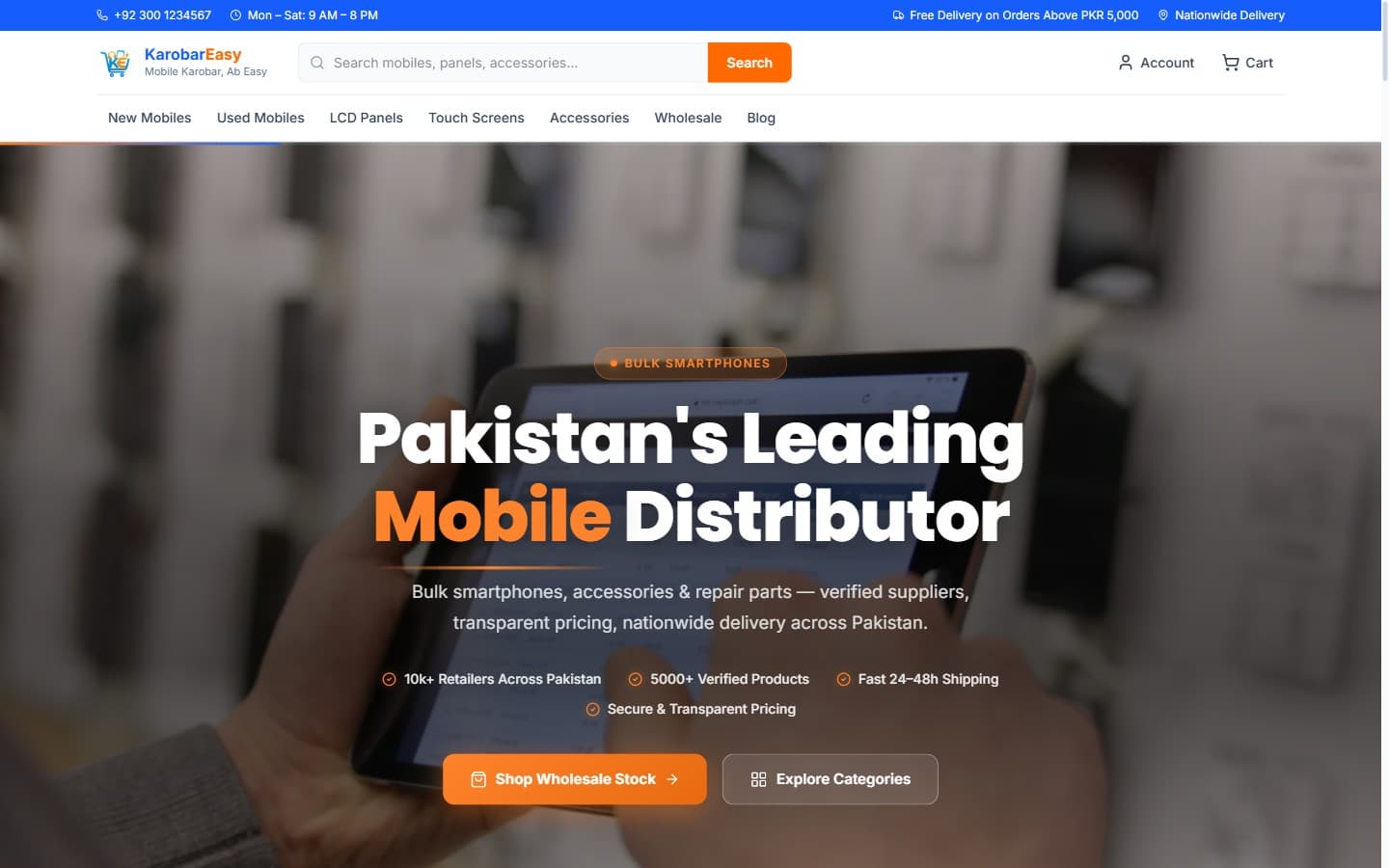
Related work · B2B Wholesale Platform
KarobarEasy
Mobile Karobar, Ab Easy — a premium B2B wholesale platform that sources mobile phones, accessories, and repair parts for 10,000+ retailers across Pakistan with bulk ordering and fast nationwide logistics.
Common questions, answered
Can customers place orders themselves?
Yes. A portal lets customers log in, see their own price list, reorder past items and track order status. Orders still pass your approval and credit rules before they are confirmed and released to the warehouse.
How does it handle partial deliveries?
Each shipment fulfils part of the order, and the unfulfilled quantity stays open as a back order. Invoices follow what was actually shipped, and customers can see what has arrived and what remains outstanding.
Does it connect to our warehouse and accounts?
Yes. Approved orders flow to picking, shipments update stock, and invoices post to the ledger by integration or export. We define which system owns each step so nothing is entered twice or contradicted.
Can sales staff enter orders from the field?
A mobile order app lets salesmen choose customers, see prices and stock, and submit orders from their phones, with offline capture for weak signal. Orders appear in the central queue the moment they sync.
More Custom Business Software services
All Custom Business Software servicesDistribution Management Software Development
Run salesman orders, deliveries, schemes and retailer credit across territories, with stock and recoveries visible to the owner every evening.
Dealer Management Software Development
Give every dealer a login to order, check credit and claim incentives, while head office sees sell-in, targets and exposure across the network.
B2B Portal Development
A trade ordering portal where business buyers see their own prices, check stock, reorder quickly and stay within agreed credit.
Ready to start your Order Management Software Development project?
Tell us what you need and we will come back with a clear scope, timeline and the questions worth answering before any build starts.