
E-commerce WebsiteDevelopment
An online store that confirms orders reliably, takes the payments your buyers actually use, and hands your team clean data for dispatch instead of a WhatsApp backlog.
E-commerce Website Development: what the work involves
Most small retailers do not lose sales because their products are weak. They lose them in the gap between a visitor deciding to buy and the order reaching a person who can fulfil it: a checkout that fails on mobile data, a cash-on-delivery order nobody confirms, stock that shows as available when the shelf is empty. A proper e-commerce site closes that gap by treating the catalogue, the basket, the payment and the dispatch as one connected flow rather than four tools stitched together by copy and paste.
We start from your catalogue and fulfilment reality: how many variants a product really has, which couriers you ship with, whether you confirm COD orders by phone. From that we design the data model in PostgreSQL, build the storefront in Next.js so category pages render fast and index well, and wire payments, courier booking and stock sync before launch. Product import from your existing spreadsheet or marketplace listings is part of the build, so you open on day one with a full catalogue and not an empty shell.
Core features
Variant-aware product model
Size, colour, bundle and per-variant stock are first-class data, so a customer never orders a sold-out combination and your team never reconciles variants by hand.
Mixed payment methods at checkout
Card payments through Stripe or a local gateway, JazzCash and Easypaisa wallets, bank transfer with proof upload, and COD with a confirmation step.
COD confirmation workflow
New COD orders land in a queue where staff can confirm by call or message, flag suspicious addresses, and only then release the order to dispatch.
Courier and shipping rules
Rate tables by city or zone, free-shipping thresholds, and booking or tracking links for the couriers you already use, written back onto each order.
Search and filtering that scales
Faceted filtering and typo-tolerant search through Algolia or Meilisearch, so shoppers find the right item in a catalogue of thousands without scrolling.
Order, return and refund tracking
Each order carries a status history, return requests and refund notes, giving support a single record to answer a customer from.
What we get right before launch
Payment security scope
Card data should never touch your server. We use hosted fields or redirects so PCI-DSS obligations stay with the gateway, and we keep wallet callbacks verified and idempotent.
Catalogue data quality
A store is only as good as its product data. Inconsistent titles, missing images and unclear sizes hurt both conversion and search ranking, so we plan an import and cleanup pass early.
Migration from marketplaces or old stores
If you already rank on an existing domain, product URLs need one-to-one redirects and carried-over metadata, or organic traffic drops after launch.
Tools and technology
- Next.js
- React
- TypeScript
- Tailwind CSS
- Supabase / PostgreSQL
- Stripe
- JazzCash
- Easypaisa
- Cloudinary
- Algolia
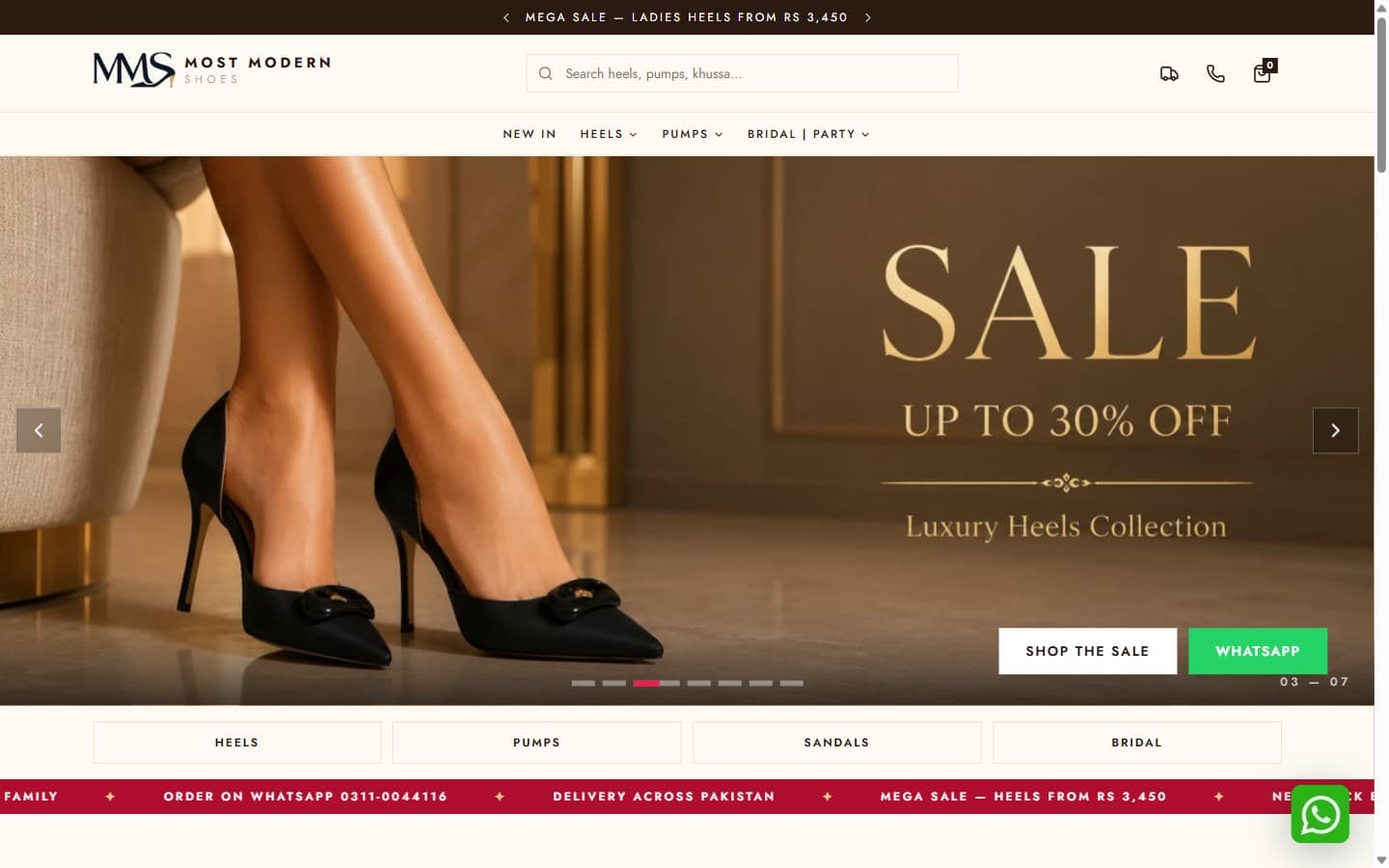
Related work · Fashion E-commerce (Footwear)
Most Modern Shoes
Rawalpindi's most-watched shoe shelf, online — heels, pumps, sandals, flats, khussa and bridal styles, ordered on WhatsApp with cash on delivery nationwide.
Common questions, answered
How long does an online store take to build?
Timeline is driven by catalogue size, number of payment and courier integrations, and how much custom back-office logic you need. A focused store with a clean product file moves much faster than one needing heavy data cleanup.
Can customers pay by cash on delivery and wallets together?
Yes. Checkout can offer COD, JazzCash, Easypaisa, bank transfer and cards side by side, with rules such as limiting COD to certain cities or order values to reduce failed deliveries.
Will I own the store and its customer data?
Yes. The code and the database are yours, hosted in accounts you control. You are not locked into a rented platform, and you can move hosting or extend the store with any developer.
Why not just use Shopify?
Shopify is a fine choice for some shops and we build it when it fits. A custom build makes sense when you need local wallets, COD workflows, unusual pricing or deep integration with your own systems.
Can you bring my existing products across?
We import from spreadsheets, marketplace exports or an old store database, normalise titles and variants, and upload images to Cloudinary so the new catalogue is complete at launch.
More Web Development services
All Web Development servicesFashion E-commerce Website Development
Fashion sells on feel and fit. The store must show the garment well, help shoppers pick the right size and make returns painless enough to keep them buying.
Wholesale Ordering Portal Development
A portal where your retailers place their own orders against their own rates and credit limits, so your salesmen stop taking orders over the phone at night.
Shopify Store Development
A Shopify store configured for how Pakistani merchants sell, including cash on delivery, local couriers and international buyers.
Ready to start your E-commerce Website Development project?
Tell us what you need and we will come back with a clear scope, timeline and the questions worth answering before any build starts.